Josie Pye
Josie Pye is one of the most consistently unpleasant figures in Anne Shirley's Avonlea world. A girl of Anne's age, she is defined by her sharp tongue, her envy, and her relentless need to assert superiority over others. Where Anne is impulsive, imaginative, and driven by a desire for love and belonging, Josie is calculating, spiteful, and motivated by a petty competitiveness that makes her a persistent source of conflict throughout Anne's early years at Green Gables and at school.
Identity and Introduction
Josie Pye is introduced as a member of the Avonlea school community, a girl whose primary characteristic is a mean-spiritedness that sets her apart from the other children. She is part of the Pye family, a clan that Marilla Cuthbert later describes with characteristic bluntness: "Josie is a Pye," she says, "so she can't help being disagreeable." From the beginning, Josie is established as a cheater—Anne catches her peeping into her book during a spelling test, a moment that crystallizes their antagonistic relationship. Josie's envy is immediately apparent; she cannot bear to see Anne succeed, and she uses every opportunity to undermine her.
Role as Antagonist and Provocateur
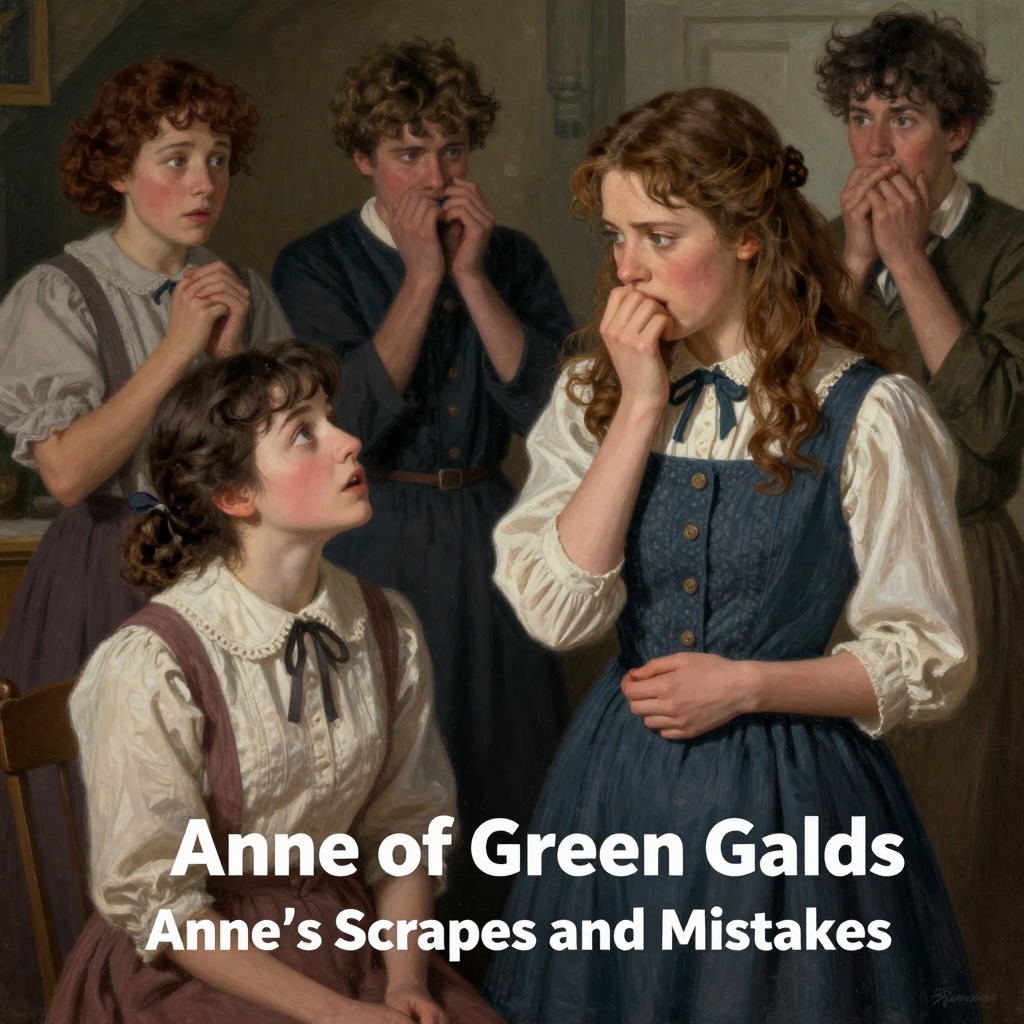
Josie's role as a provocateur is most dramatically displayed in the "daring" incident at Diana Barry's party. When the girls are playing at daring each other, Josie, having just triumphed over Jane Andrews, goads Anne by flatly disbelieving her claim to have known a girl who could walk a ridgepole. "I don't believe it," Josie says, and then delivers the fatal dare: "Then I dare you to do it. I dare you to climb up there and walk the ridgepole of Mr. Barry's kitchen roof." This dare, issued with a "defiant glance," directly leads to Anne's fall and broken ankle. Josie's motivation is not mere mischief but a calculated desire to humiliate Anne, and when Anne falls, Josie is seized with "horrible visions of a future branded as the girl who was the cause of Anne Shirley's early and tragic death." This moment reveals that Josie's cruelty is not without its own anxious consequences, but it does not change her behavior.
Persistent Rivalry and Malice
Josie's antagonism is not a one-time event but a persistent thread throughout the narrative. She is a constant presence in the schoolroom, where she "maliciously" smiles at Anne's public humiliation after the slate incident. She is the source of cutting remarks, telling Anne that she looks "like a perfect scarecrow" after her hair is cut short. When Anne wins the Avery scholarship, Josie is quick to diminish the achievement, informing her that "Frank Stockley says that Professor Tremaine said Gilbert Blythe was sure to get the medal and that Emily Clay would likely win the Avery scholarship." Even in the context of Anne's triumph, Josie's words are designed to inject doubt and steal joy. She also spreads gossip, telling Anne that a boy at Queen's asked "who the red-headed girl was" and that she informed him Anne was "an orphan that the Cuthberts had adopted, and nobody knew very much about what you'd been before that." This casual cruelty, delivered with "aggravating pity," underscores Josie's role as a social poisoner.
Thematic Significance: A Foil to Anne
Josie Pye serves as a crucial foil to Anne Shirley. Where Anne is defined by her capacity for imagination, joy, and deep feeling, Josie is defined by her lack of these qualities. Anne herself notes this contrast, observing that Josie "has so little imagination." Josie's world is one of petty social hierarchies and mean-spirited competition, a world that Anne must learn to navigate without losing her own essential self. Anne's struggle to like Josie—a struggle she explicitly discusses with Marilla—becomes a measure of her own moral growth. "I've made what I would once have called a heroic effort to like her," Anne confesses, "but Josie Pye won't BE liked." This admission is not a failure on Anne's part but a recognition of the limits of even the most generous spirit when faced with unrelenting malice. Josie represents the kind of small, ungenerous soul that Anne's expansive heart must learn to endure, and ultimately, to transcend. Her presence in the story ensures that Anne's victories—whether academic, social, or personal—are hard-won and never free from the sting of opposition.